Strategic Plan
Strategic Plan
Strategic Plan
Community Newsletters
Shaping Our Future Sessions
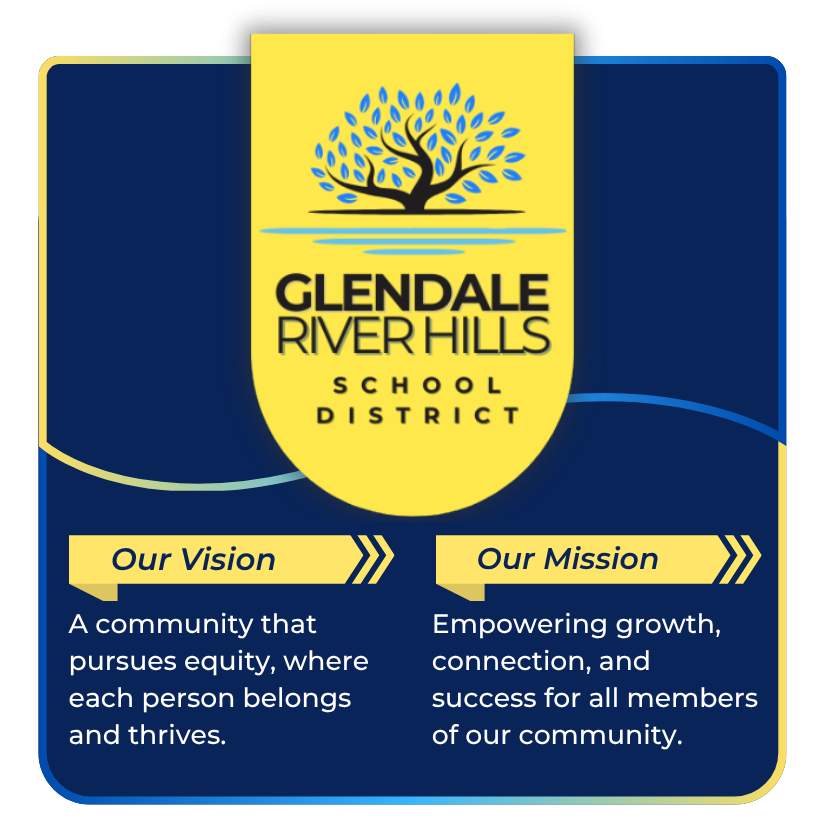
Strategic Plan and Pillars
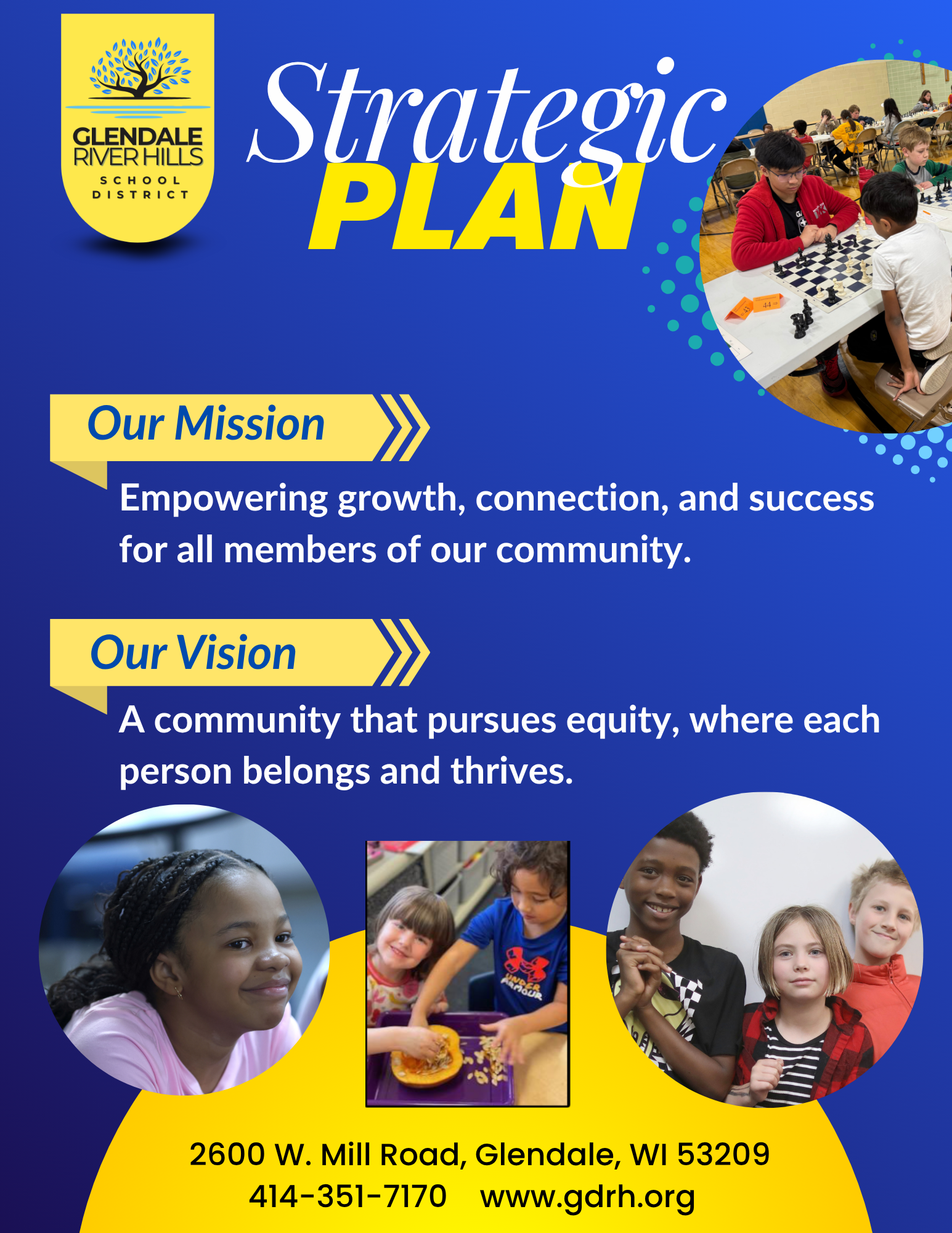
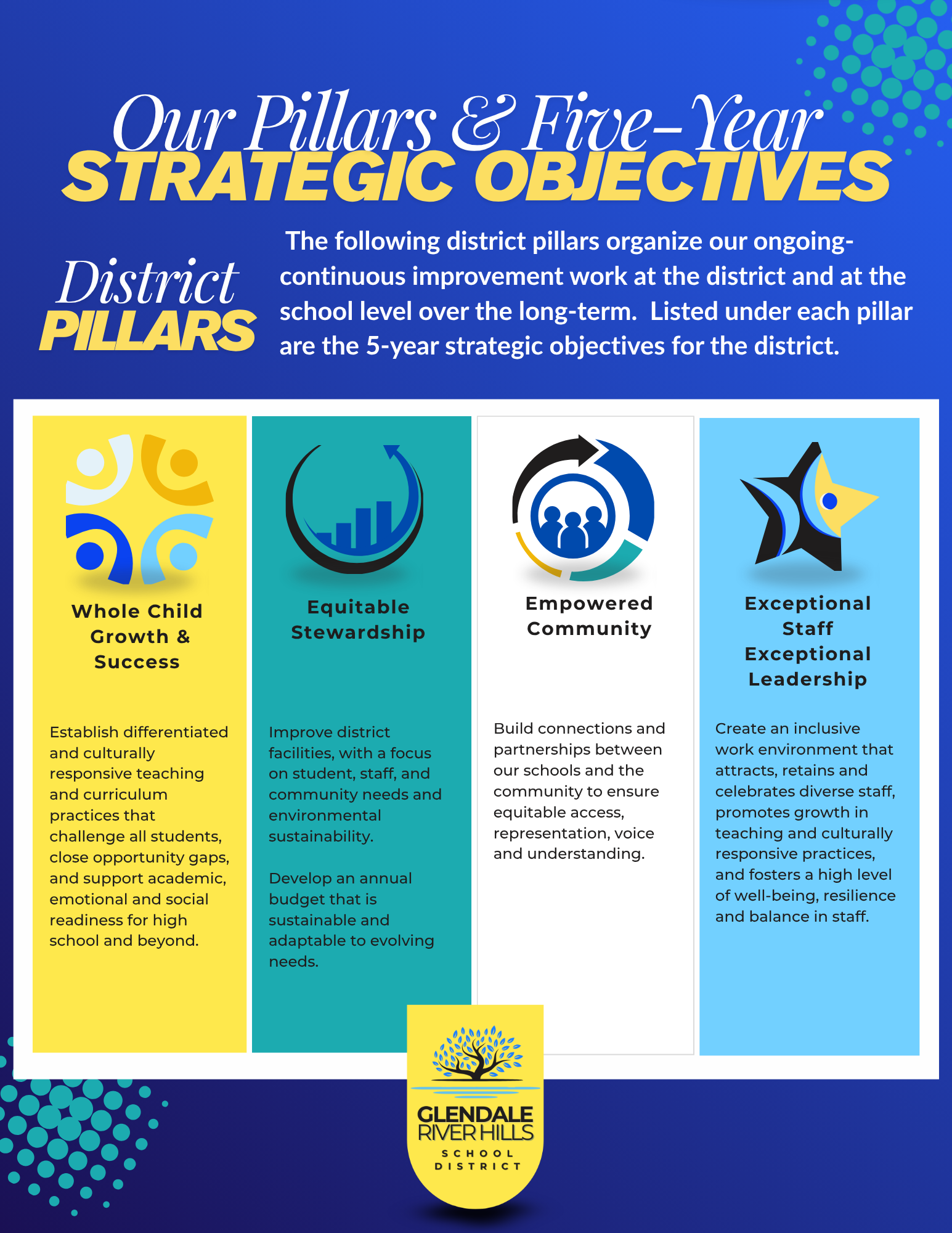
Strategic Plan - Key Performance Indicators
-
By the end of the 2028-29 School Year, 75% of students will meet the high growth expectations as measured by Student Growth Percentiles in Math and Reading using AIMSWEB (Parkway) and STAR (Glen Hills)
2024-25
2025-26
2026-27
2027-28
2028-29
Reading Parkway
N/A
R-(2-3) 35.6%
EL-(K4-1) 39.4%
Math Parkway
N/A
M- (2-3) 27.5%
EN-(K4-1) 53%
Reading Glen Hills
37%
36.2%
Math Glen Hills
36%
30.5%
-
By the end of the 2028-29 School Year, the academic achievement gap for identified sub groups will be 0% as measured by Student Achievement Percentiles in Math and Reading using AIMSWEB (Parkway) and STAR (Glen Hills).
2024-25
2025-26
2026-27
2027-28
2028-29
Reading Parkway
N/A
R(2-3) 39.42%
EL (K4-1) 32.9%
Math Parkway
N/A
M (2-3) 41.5%
EN (K4-1) 32.3%
Reading Glen Hills
32%
43.4%
Math Glen Hills
38%
50.1%
-
By the end of the 2028-29 School Year, the district will achieve a 4.5 out of 5.0 survey score for School Environment "I like being at school because it is safe, warm, and fun." as measured by the annual district Student Survey.
2024-25
2025-26
2026-27
2027-28
2028-29
School Environment Score
3.62
3.50
-
*By the end of the 2028-29 School Year, the district will expand the percentage of students involved in one or more school activities by ______%. *Baseline data will be collected in the 2025-26 School Year to set KPI goal.
2024-25
2025-26
2026-27
2027-28
2028-29
% Student Involved in Afterschool School Activities
N/A
49%
-
By 2028-29 100% of 9th graders from Glen Hills will be on track to graduation by the end of their 9th grade year at Nicolet.
2024-25
2025-26
2026-27
2027-28
2028-29
% On Track to Graduation
97%
98.8%
-
By the end of 2028-29 School Year the district will retain 95% of its professional staff.
2024-25
2025-26
2026-27
2027-28
2028-29
% Retained
91%
92% w/retirees
94%
w/out retirees
-
By the end of the 2028-29 School Year the district will achieve an 8.5 out of 10.0 survey score for Overall Satisfaction with working in the district as measured by the annual Staff Survey.
2024-25
2025-26
2026-27
2027-28
2028-29
Overall Satisfaction Score
6.42
6.85
-
By the end of the 2028-29 School Year, 85% of staff will agree or strongly agree that they have the opportunity and training needed to improve their work as measured by the annual Staff Survey.
2024-25
2025-26
2026-27
2027-28
2028-29
% Agree or Strongly Agree
67%
73%
-
By the end of the 2028-29 School Year, the district will achieve an 8.5 out of 10.0 survey score for Overall Satisfaction with the district as measured by the annual district Parent/Family School Survey.
2024-25
2025-26
2026-27
2027-28
2028-29
Overall Satisfaction
6.64
7.01
-
By the end of the 2028-29 School Year, 95% of parents/families will agree or strongly agree that our schools provide opportunities for parent involvement as measured by the annual Parent/Family Survey.
2024-25
2025-26
2026-27
2027-28
2028-29
% Agree or Strongly Agree
85%
85%
-
By the end of the 2027-28 School Year, 68% will agree or strongly agree that the district keeps the public informed as measured by the bi-annual Community Survey.
2024-25
2025-26
2026-27
2027-28
2028-29
% Agree or Strongly Agree
48%
N/A
-
By the end of the 2028-29 School Year, the percentage of resident students opting to open enroll out for the Glendale-River Hills School District will be lower than 5%.
2024-25
2025-26
2026-27
2027-28
2028-29
% Open Enrolled Out
11%
10%
-
From 2025-26 to 2028-29 the district will meet the indicator of Financial Transparency by maintaining up to date monthly financial reports on the district website and holding bi-annual community budget meetings.
2024-25
2025-26
2026-27
2027-28
2028-29
Monthly Financials on Website
Partially
Met
Partially
Met
Bi- Annual Budget Meetings
Partially
Met
Met
-
From 2025-26 to 2028-29 the district will maintain a 10% or greater Fund Balance of the prior year's annual budget.
2024-25
2025-26
2026-27
2027-28
2028-29
Fund Balance % of Prior Years Budget
40.25%
19.44%
-
From 2025-26 to 2027-28 the district will achieve a balanced budget annually with reserves.
*2025-26 Budget was intentionally not balanced because $3million in prepayment of debt was made. This increases available revenue in the general fund, saves taxpayers over $800,000 in interest payments, and stabilizes the districts S&P rating outlook.
2024-25
2025-26
2026-27
2027-28
2028-29
Balanced Budget
Yes
No*
% Reserves
40.25%
19.44%
Community Newsletters

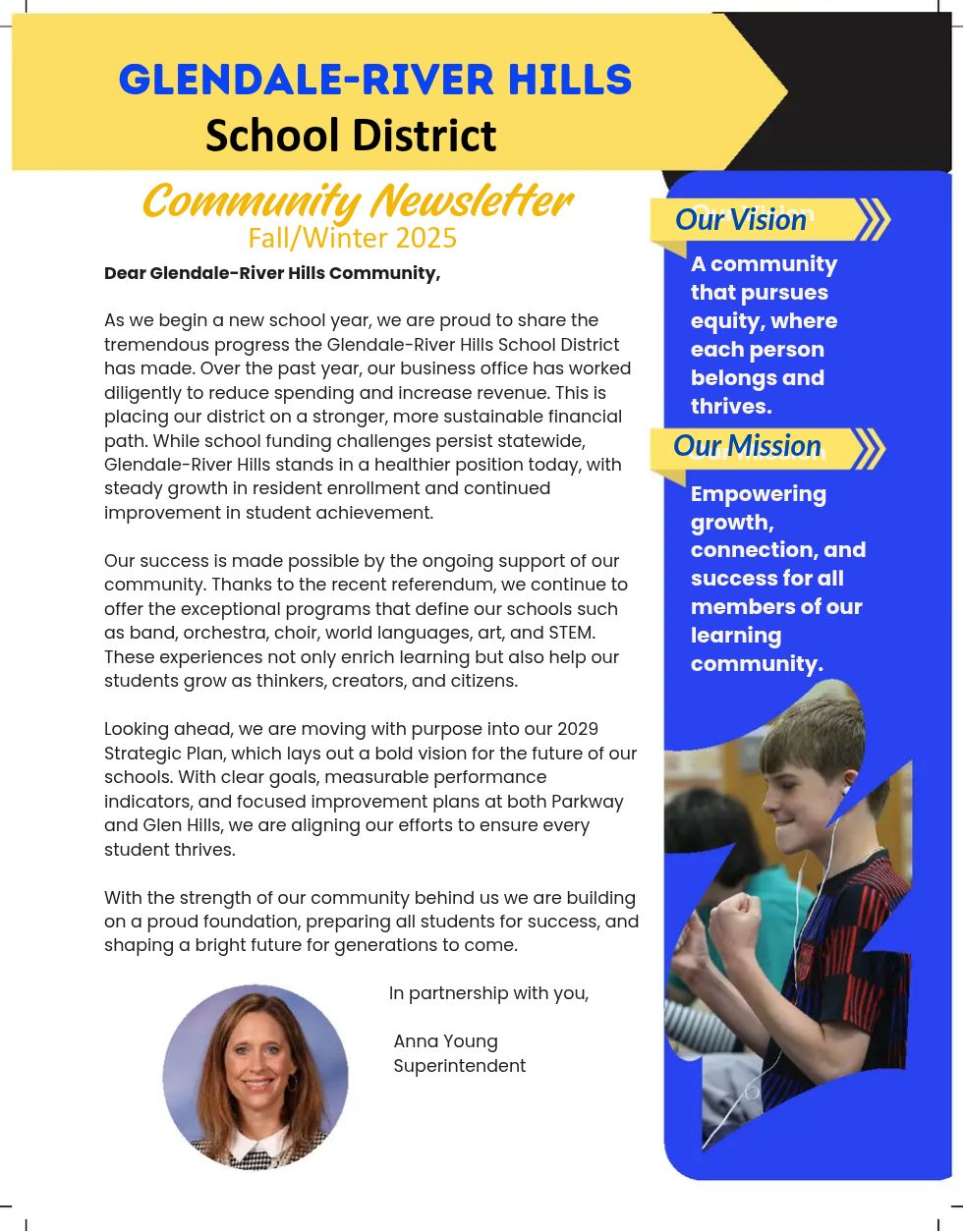
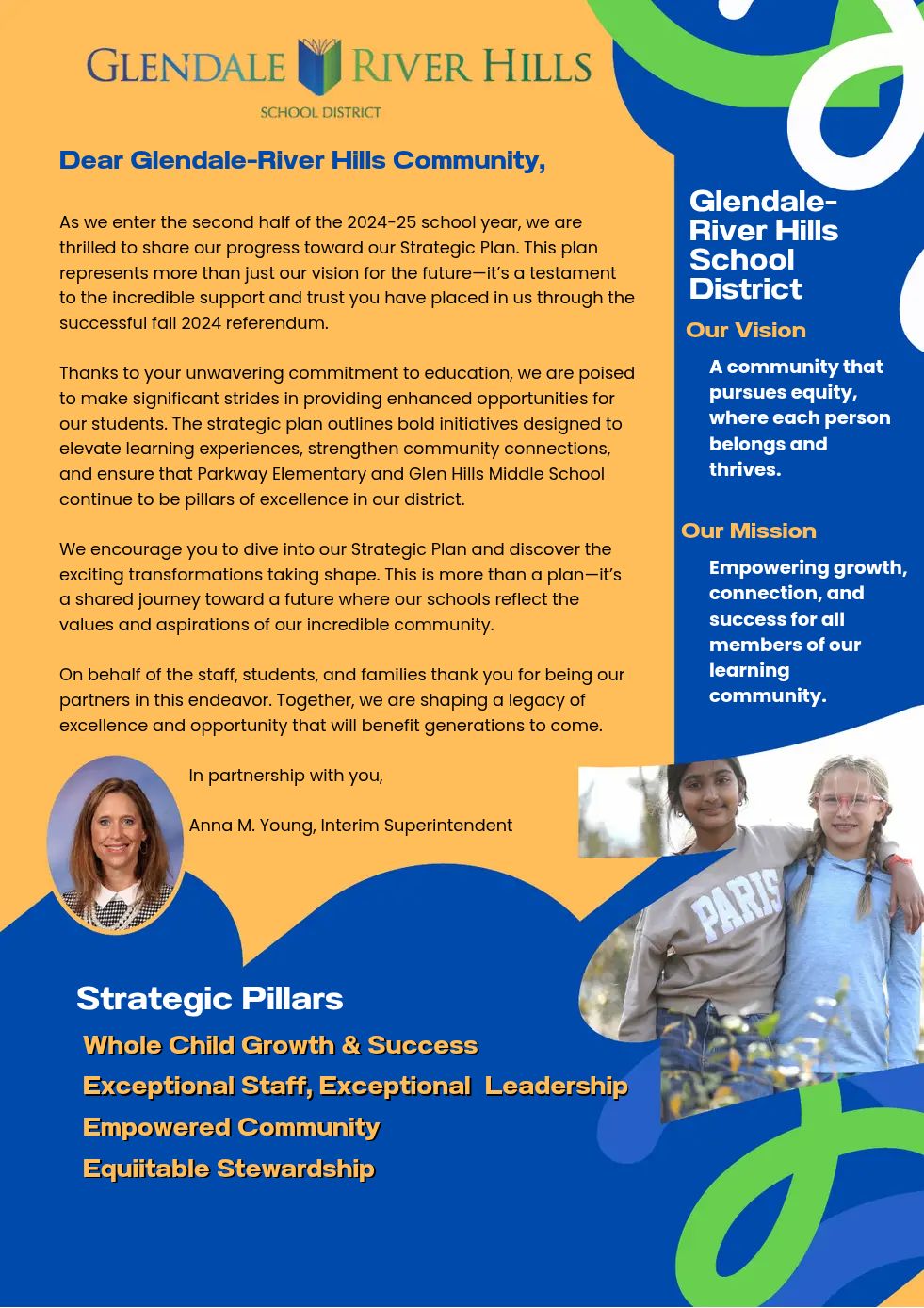
Shaping Our Future Together
The recent Shaping Our Future Together: Empowering Success in GDRH community sessions, where we engaged with over forty community partners over two sessions to reflect on our district’s rich history and chart a course for the future.
Celebrating Our Legacy
Participants explored the history of our schools in Glendale-River Hills and identified key components of our ongoing legacy, including:
- Strong Music Programming, Tech Ed, and Arts
- Robust Club Offerings and Student Leadership Opportunities
- Athletic Programming
- PTO Events That Engage Families
- Community Partnerships, including Scouts
- Increased Diversity Among Students and Staff
Priorities for Enhancing Learning
As we look ahead, participants outlined priorities to strengthen student learning and well-being. The following priorities were identified:
- Experiential, Hands-on Learning
- Mental Health Services
- Reading and Math Improvement Programs
- Opportunities for Real-World, Authentic Learning
- Opportunities for parents & teacher to work together for student success
Essential Skills for Graduating Students
Community members expressed a strong desire for our 8th-grade students to graduate with the following key skills, framing the underlying community values for our young people:
- Critical Thinking and Problem Solving
- Effective Communication
- Strong Academic Skills in Math & Literacy
- A Sense of Self and Community
- Leading with Influence
Enrollment Trends and Class Size Considerations
A review of enrollment trends indicated steady enrollment in the district. Participants discussed the recent decrease in open enrollment and the district’s ability to maintain class size ratios. A key discussion point was the potential move from five to four sections at the middle school level, leading to slightly increased class sizes. While larger class sizes in upper grades are not uncommon, there were questions about whether maintaining smaller class sizes at these levels could positively impact learning and student behavior.
Financial Outlook and Fiscal Responsibility
A presentation on the district’s financial future highlighted:
- Historic Mill Rate Trends – While the mill rate has dropped in recent years, this does not account for inflationary increases in home values, which impact taxpayers.
- Upcoming Fiscal Cliff – Projections indicate that in three years, the district will likely face a fiscal cliff due to the state funding model. This may require a referendum to increase the revenue limit to maintain current educational opportunities.
- Fiscal Stewardship – Participants stressed the importance of transparency and responsible financial management. They recommended making financial information readily accessible on the district’s website and through school communications.
Facility Planning and the Future of Good Hope
Participants engaged in discussions about our three-building configuration and the future of the Good Hope property. Several ideas emerged, including:
- Selling the property
- Turning it into a community resource center
- Increasing rental rates to cover maintenance costs
- Retaining the land and demolishing the building
There was broad consensus that the design, maintenance, and updates of our facilities should prioritize compliance, inclusivity, safety, and appeal to incoming families.
Moving Forward
These sessions provided valuable insights that will inform our district’s planning and decision-making. We remain committed to honoring our legacy while strategically preparing for a future that best serves our students, staff, and community. Future engagement sessions will be held to foster fiscal transparency and garner community input and leadership around:
- Clarifying Essential Skills for Graduating Student
- Audit and Recommendations for Student Programing EC-8th
- Operational Strengths and Opportunities
- Facility Tours and Review of Accessibility and Maintenance Needs
- Facility Strengths and Opportunities